
In stock
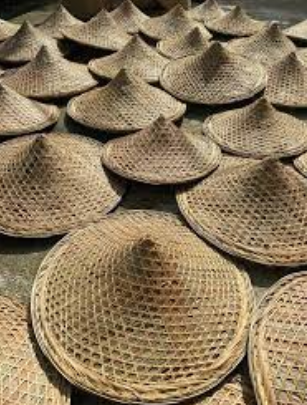
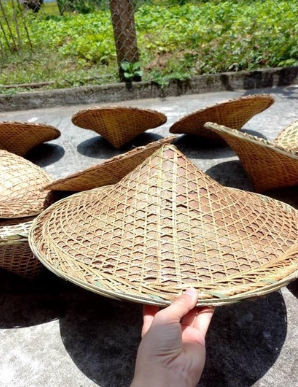
Cao Bang conical hat
Quantity
An tâm đặt hàng cùng tour
Sản phẩm đã qua kiểm duyệt từ tỉnh Cao Bằng.
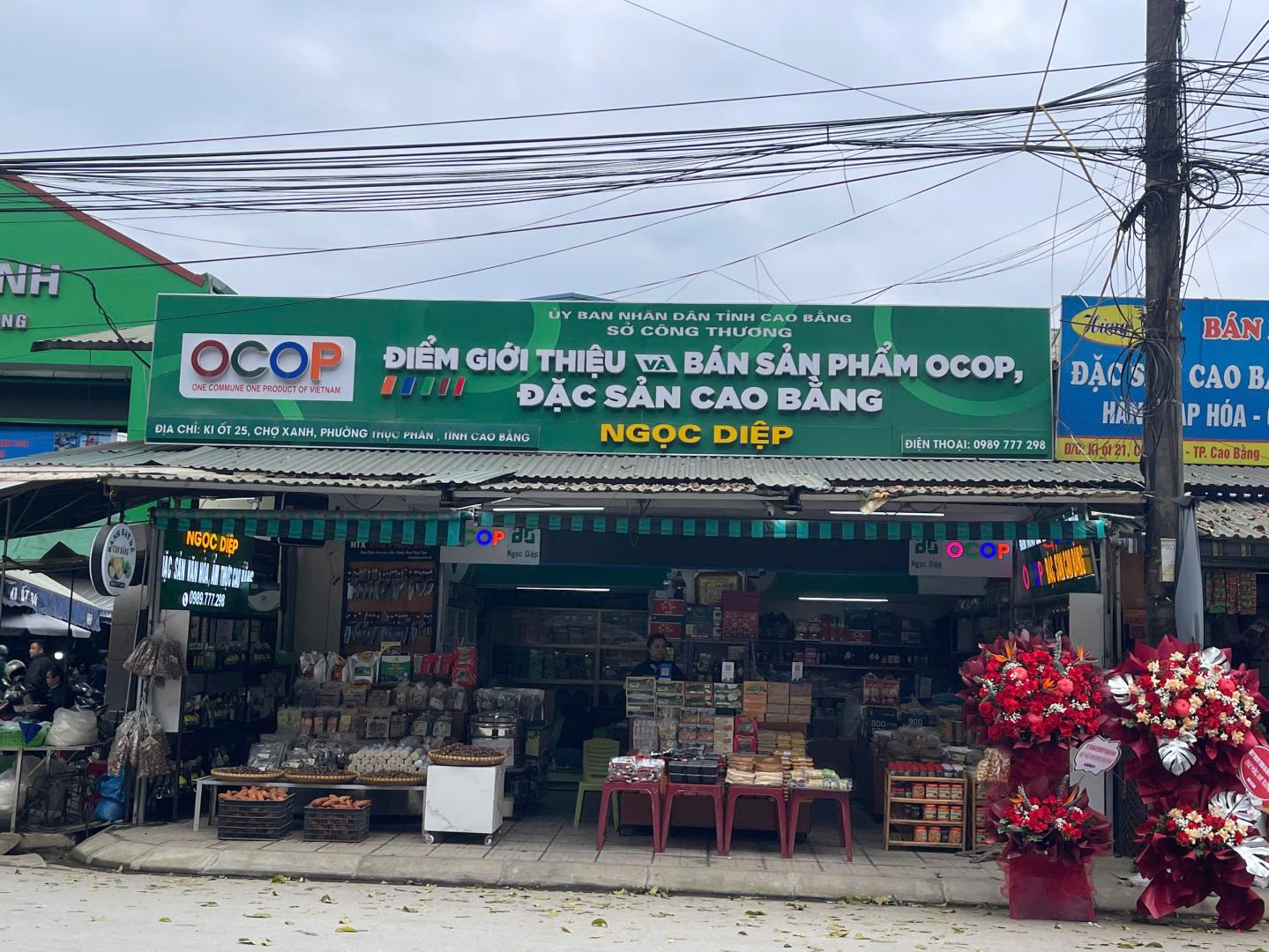
Ngoc Diep - Showroom and Sales Point for OCOP Products and Specialties of Cao Bang
Product description
Through the ups and downs of time, the craft of weaving conical hats has been preserved, maintained, and developed by the people of Hoang Dieu hamlet, Tu Do commune (Quang Hoa district), becoming one of the traditional crafts that provides income for the local people.
The conical hat is closely associated with the daily life of the Nung An people. The hat is a familiar item, a companion to the people in their work and daily lives. It's used to protect from the sun and rain, accompanying farmers to the fields, women to enhance their beauty, or, more intimately, the cool breeze a grandmother uses to fan her grandchildren to sleep. Besides that, today, the conical hat is also used as an artistic decoration, appearing in exhibitions, as a prop in graceful singing and dancing performances, or in creative design ideas. In particular, the conical hat (chúp xà) is considered a refined, impressive, simple, and practical gift that still embodies the traditional culture of the ethnic groups for tourists visiting and experiencing the mountainous region of Cao Bang.
Hoang Dieu hamlet has 112 households and 506 inhabitants. In May 2023, with the joint efforts and support of various departments and agencies, 22 households established the Hoang Dieu Conical Hat Production Cooperative. To date, the number of households participating in the Cooperative has increased to 34.
No one remembers when the craft of making conical hats in Hoang Dieu hamlet began. They only know that generation after generation has passed down the art of weaving these hats. Ms. Hoang Thi Dep, from Hoang Dieu hamlet, shared: "In Hoang Dieu hamlet, everyone knows how to weave hats; parents teach their children, and then their children teach their grandchildren. Despite the changes in life, generations of people here have silently kept the flame alive for this craft." People believe that preserving the craft is preserving the culture of their homeland. Making a complete conical hat requires many steps and takes a lot of time. The materials used are usually the stems of the *Mây thành* tree, *Mây mè*, *Mây mười* leaves, banana leaves, etc. Although the hat seems simple, completing it requires many elaborate steps. From preparing the materials to the finished product, a *chúp xà* hat goes through three main stages: creating the frame, creating the inner lining, and securing the hat.
First is the frame. The hat frame consists of two parts: the upper frame and the lower frame. The upper frame is usually made from the stem of the *Mây thành* tree, and the lower frame is made from the stem of the *Mây mè* tree. Depending on the size of the hat, for a *chúp xà* hat with a diameter of 30 cm, the *Mây thành* is split to a length of 40-50 cm. It consists of 56 thin strips, each 1 cm wide. The outer layer of the hat is woven tightly, with each slat spaced 3-5 cm apart, creating small, even, and beautiful diamond-shaped or eye-shaped patterns. In the final rounds, the slats are folded and overlapped to form the brim of the hat, known as the bamboo loop.
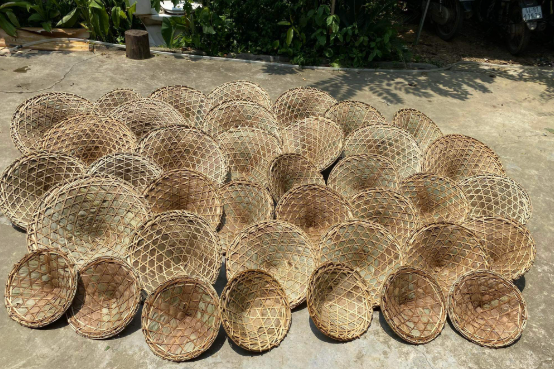
The inner layer of the hat is smaller. Typically, for a conical hat with a diameter of 30 cm, the inner layer is made of 32 slats, split to a length of 30-40 cm. The inner layer doesn't need to be woven too tightly; usually, the slats are spaced 5-10 cm apart, creating larger diamond-shaped or eye-shaped patterns, large enough for a child's fist to fit through. In the final rounds, the inner layer is folded and overlapped to form the brim.
The layer between the outer and inner layers is the lining, made from the leaves of the May Muoi plant and dried banana leaves. The leaves of the May Muoi tree and banana leaves, after being harvested, must be dried in the sun. Then, depending on the size of the hat, they are trimmed and arranged to completely cover the hat frame. Usually, there will be two layers of May Muoi leaves sandwiched between one layer of dried banana leaves.
The middle layer of leaves, after being arranged, compressed, and secured by the two layers of frame, requires a final step: "Slam Theo." "Slam" in the Nung ethnic language means three, and "theo" means stick. Slam Theo consists of three long, rounded sticks, 100-150 cm long, wrapped around the brim of the hat, securing the two parts of the hat frame and the middle lining together.
0.0 / 5
0 Reviews
Review filter: