
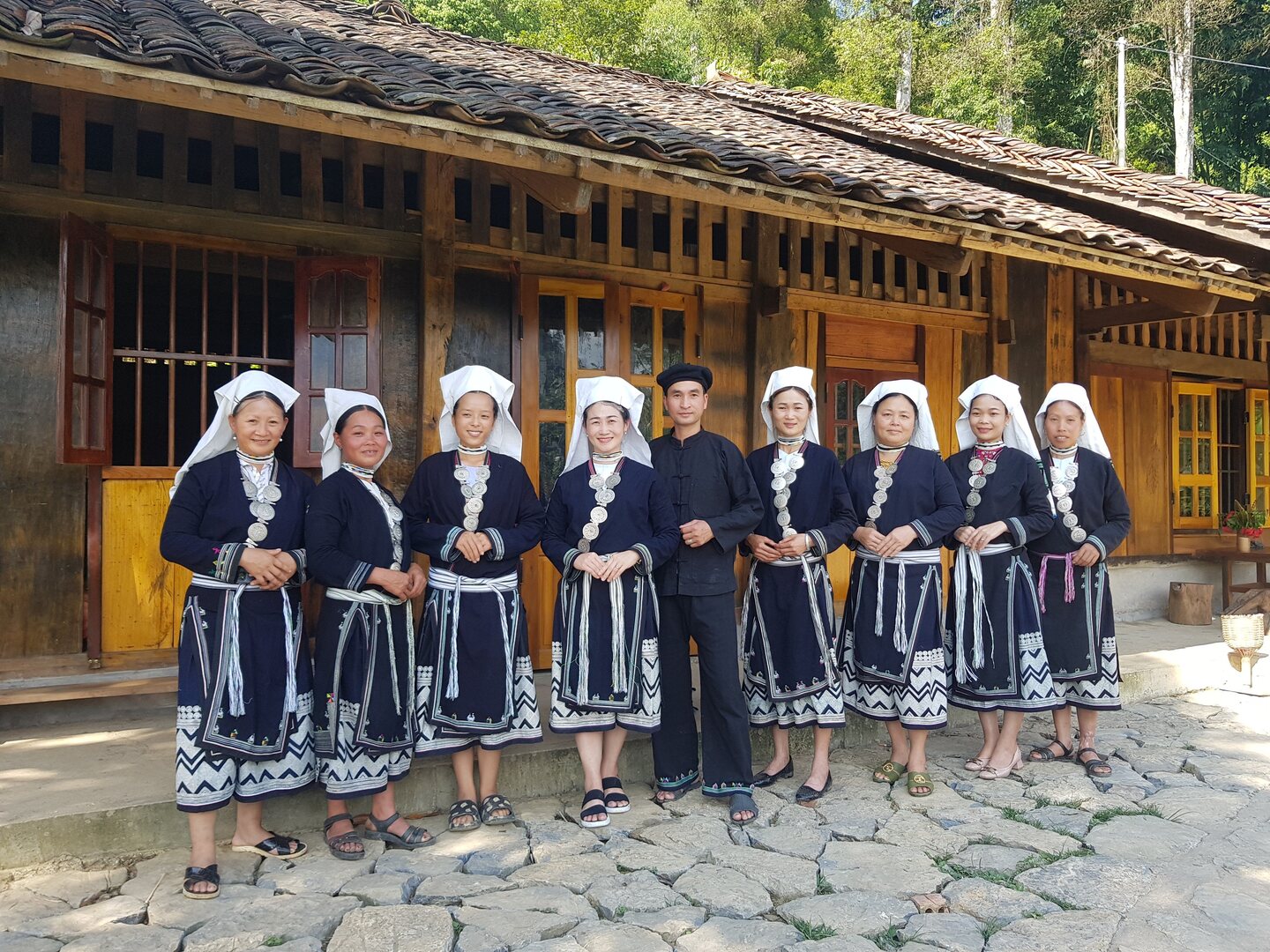
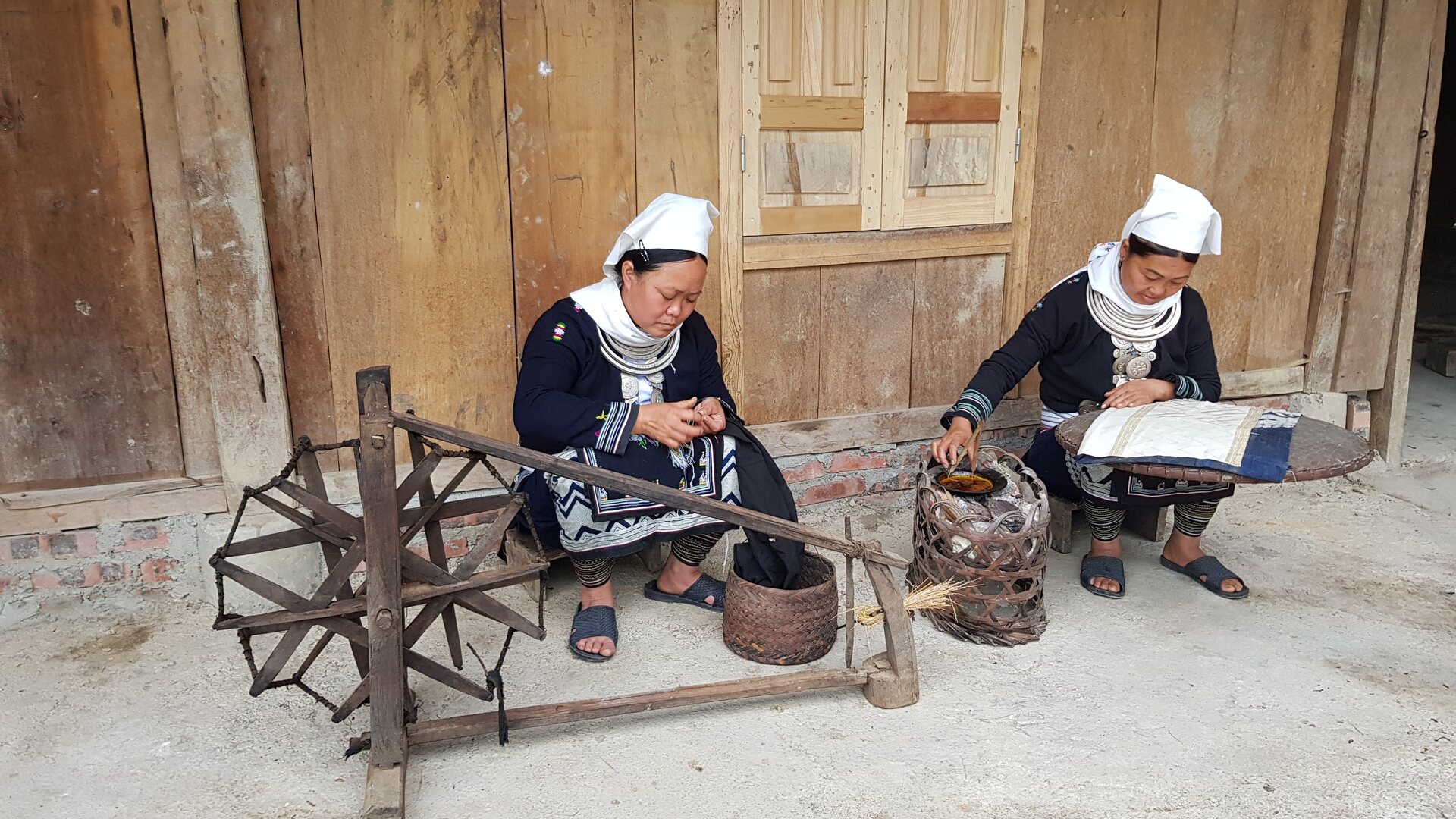
On white fabric woven from jute or cotton fibers, the women apply patterns using heated beeswax. Once the patterns are applied, the fabric is dyed in an indigo vat. When the desired shade is achieved, the cloth is dipped into boiling water; the heat causes the beeswax to melt away, revealing intricate designs against the rich indigo background. With skillful hands, the Dao Tien women also embroider geometric shapes, plants, flowers, leaves, birds, and animals onto the textiles. These beeswax-patterned and embroidered fabrics are primarily used to craft clothing, blankets, bedspreads, and pillowcases.
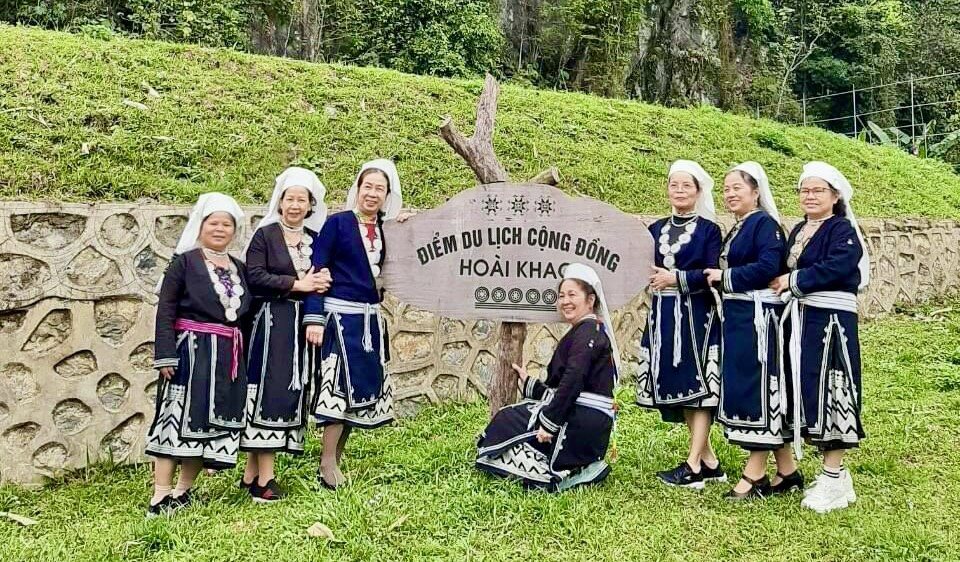
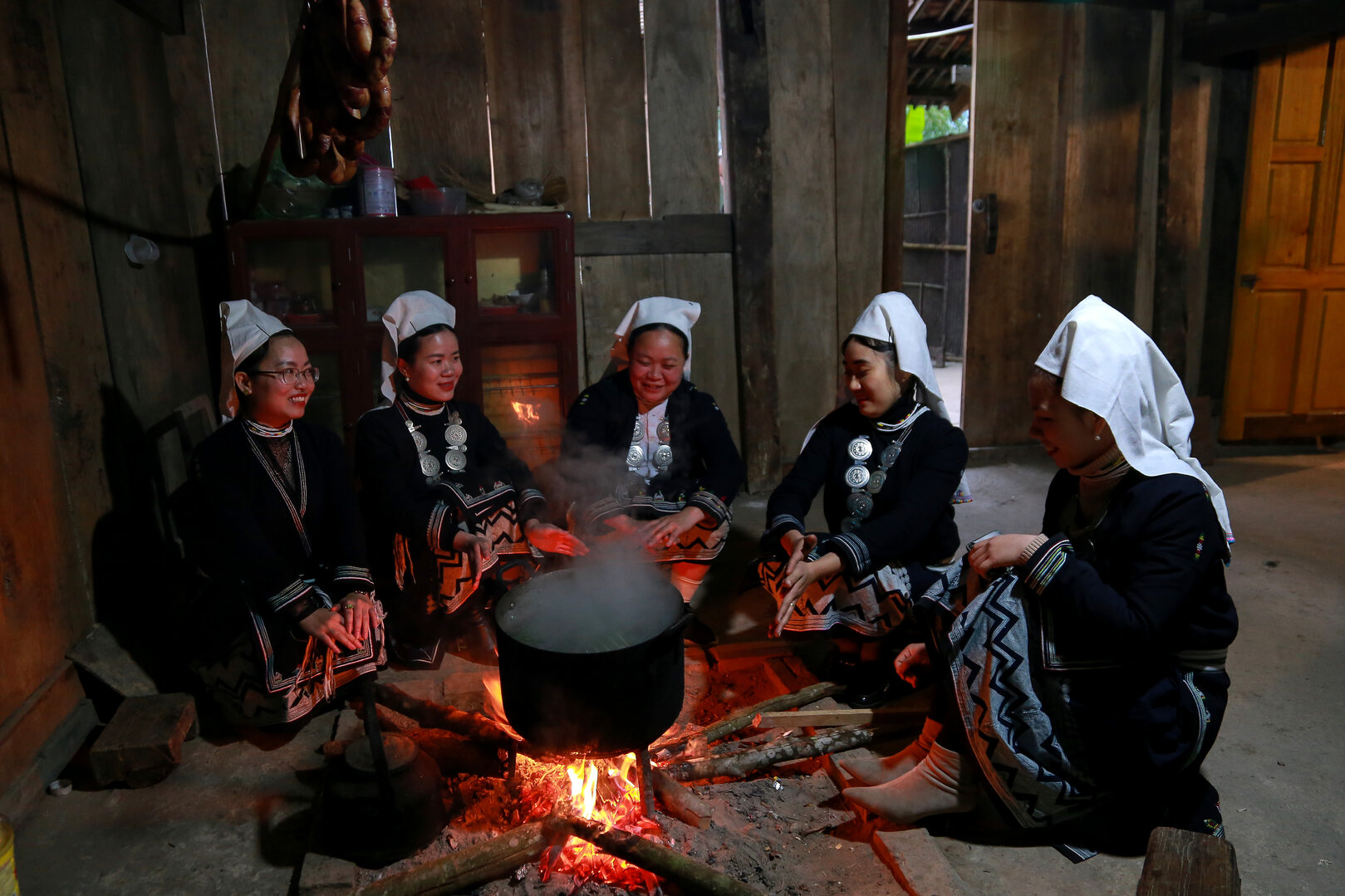
Visitors to Hoai Khao hamlet (Thanh Cong commune) or Na Chan hamlet (Tam Kim commune) can observe and even participate in the unique traditional processes of beeswax patterning and embroidery practiced by the Dao Tien people.
A Folk Tale About the Wedding Attire
- According to elderly Dao Tien artisans, in ancient times, people wore simple, unadorned garments made of plain white or greyish-black coarse fabric.
At that time, there lived a beautiful young woman in the village—a virtuous and skillful soul who was soon to be married. She wished to create a magnificent and truly unique wedding outfit for her special day. She wove a piece of smooth, pristine white cotton fabric, but for many days, she struggled to figure out how to adorn it with beautiful designs.
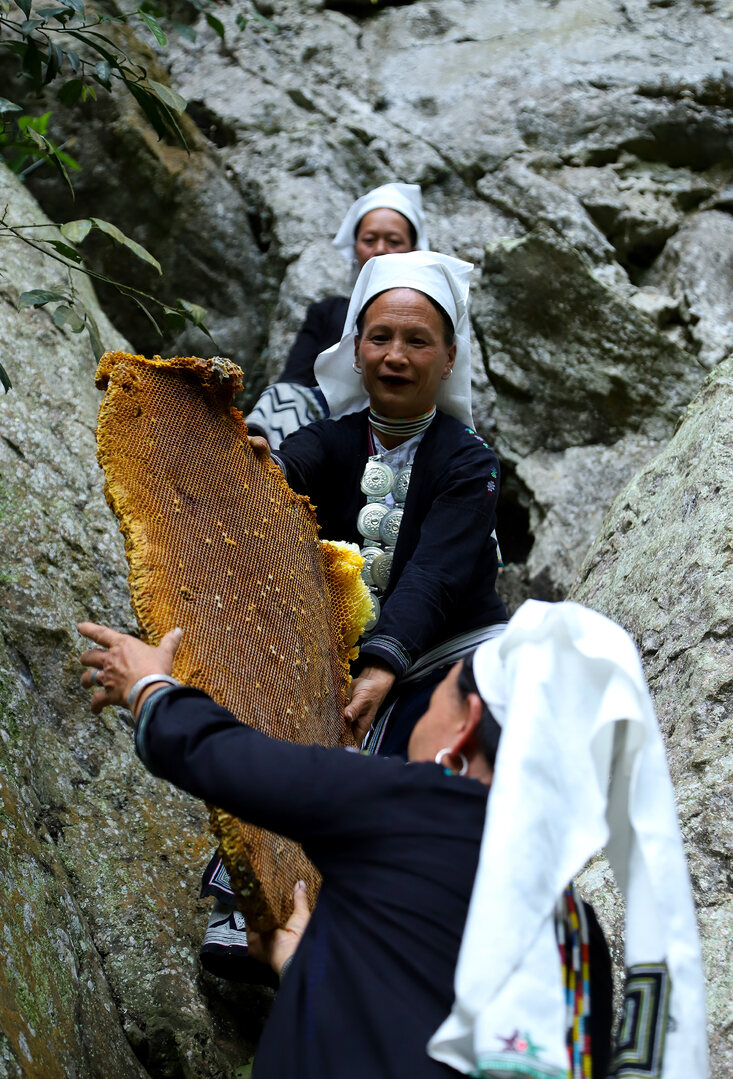
- One day, while she was sitting near the edge of the forest, a swarm of wild honeybees flew by, and a drop of hot wax fell, sticking firmly to her white fabric. She tried to scrape the wax off, but could not remove it completely. When she took the fabric to be dyed with indigo, she was astonished: after repeated immersions in the indigo vat followed by drying, the entire piece of cloth turned a deep, dark blue-black—except for the areas covered in beeswax, which remained completely untouched by the dye, revealing striking, ivory-white patterns.
- Discovering this secret, she ventured into the forest to find the nests of wild honeybees, collecting the wax to melt down. Using small, sharpened bamboo sticks dipped into the molten wax, she drew familiar motifs from the mountains and forests—such as coins and rippling water—onto the fabric. Once dyed, her wedding skirt emerged adorned with delicate white patterns set against a rich, indigo-blue background. She subsequently shared this technique with all the women in her Dao Tien village.
The Crafting Process: Combining Beeswax with Geometric Tools
- Unlike other ethnic groups that use a stylus for freehand drawing, the Dao Tien people employ a highly ingenious and meticulously calculated set of printing tools:
- Beeswax for Adhesion: They use wax from wild honeybees (yellow wax) to ensure it adheres to the fabric. The wax is melted over a charcoal fire and kept at a precise temperature—warm enough to remain fluid, yet cool enough to prevent it from becoming too runny and blurring the designs.
- Bamboo Printing Molds: Dao Tien women craft molds by thinning and shaping small pieces of bamboo. They dip these molds into the hot wax and apply them steadily across the surface of the fabric.
- Coin Motifs: A signature element on the skirts of the Dao Tien people is the circular coin motif (which alludes to the origin of the name "Dao Tien," or "Coin Dao"). They use small bamboo segments or hollow copper tubes as stamps to create perfectly uniform geometric patterns, achieving precise, consistent designs without the need for a measuring tool. - Indigo dyeing: After the wax-resist patterns are applied, the fabric undergoes an indigo-dyeing process, being dipped into the dye 20 to 30 times. Once the desired shade of indigo is achieved, the fabric is submerged in boiling water. The high temperature causes the beeswax to melt away completely, revealing the original white patterns against the cotton fabric.
Development and preservation within modern tourism
- Today, the beeswax-resist pattern printing craft of the Dao Tien people has expanded beyond the confines of individual households, becoming a core experiential tourism product:
- Hoai Khao Community-based Tourism Village: This location serves as the best-preserved site for Dao Tien culture in Cao Bang. Visitors can not only observe the craft but also receive hands-on guidance from artisans, learning to use the tools to apply beeswax and create patterns on items such as scarves and souvenir bags.
- Elevation to OCOP (One Commune, One Product) status: Traditional garments, bags, and tablecloths featuring beeswax-resist patterns have been redesigned to align with contemporary tastes. These pieces have evolved into high-quality souvenirs, providing a stable source of income for local women.