
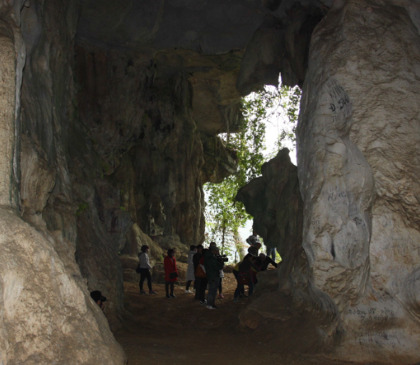
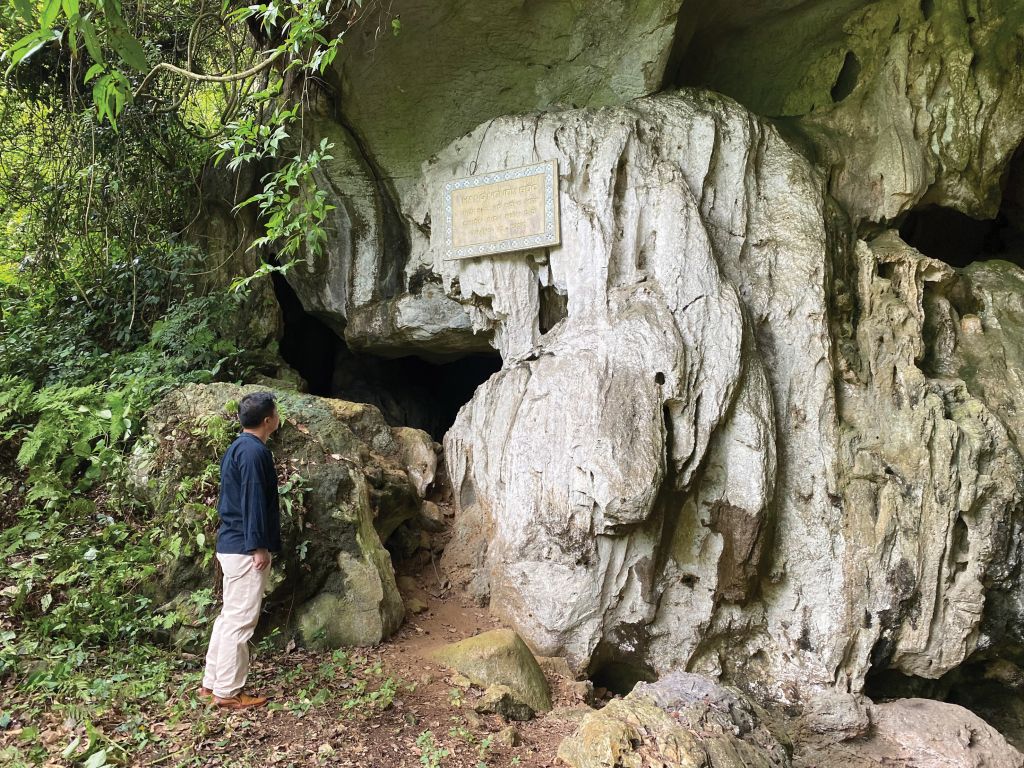
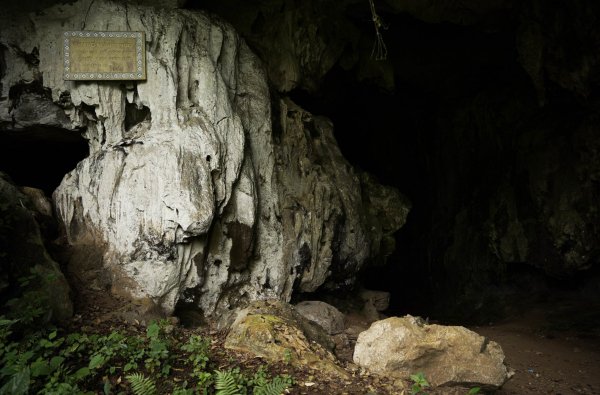
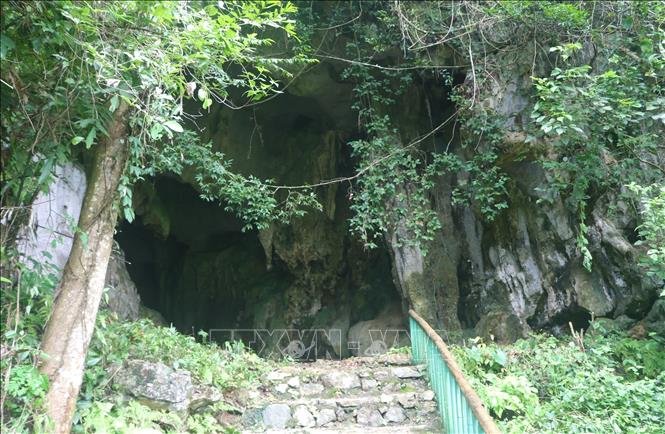
Ngườm Bốc – meaning "Dry Cave" in the local dialect – is located on the western slope of the Lam Sơn mountain range, in Bản Nưa hamlet, Lam Sơn village, Hòa An commune. This is a place that marks many historical events related to the revolutionary activities of President Ho Chi Minh during the years 1942-1945. From the end of March to August 1942, President Ho Chi Minh moved from Pác Bó to the Lam Sơn base to direct the revolution. Here, he often secretly passed through Ngườm Bốc cave, affectionately called "Ông Ké" (Old Man) by the local people. In May 1945, at Ngườm Bốc cave, President Ho Chi Minh attended a meeting with the leaders of the Cao-Bắc-Lạng Inter-Provincial Committee to prepare for the historic August 1945 general uprising.
Ngườm Bốc was also where the Lê Tổ military workshop was located and worked during the resistance war against the French. In October 1950, President Ho Chi Minh attended and directed the conference summarizing the Border Campaign here; he also spoke with workers at the Le To military factory and representatives of the people of Hoa An commune.
Archaeologists have also found many sites in Nguom Boc indicating that it was once a dwelling place of prehistoric people from the early Neolithic period, equivalent to the early Hoa Binh Culture, dating back about 10,000 years.
In the famous legend of Pu Luong - Slao Cai of the Tay people, Nguom Boc is the first place where these two legendary figures resided in Cao Bang province.
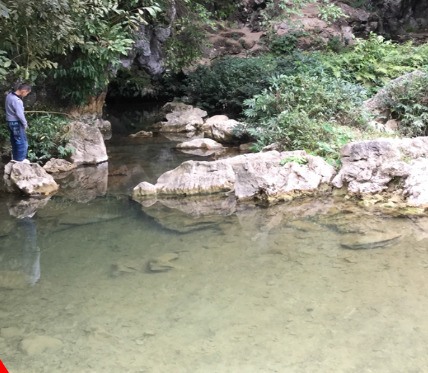
Geologically, Ngườm Bốc Cave developed in limestone formed under shallow, warm marine conditions approximately 360-270 million years ago (Carbon Permian period). At the cave entrance, traces of ancient terraces and streams are still clearly visible, indicating that it was uplifted in a recent period (known as the Neotectonic period).
Ngườm Bốc Cave was recognized as a National Revolutionary Historical Monument according to Decision No. 02/2004/QD/BVHTT of the Ministry of Culture, Sports and Tourism dated January 19, 2004.